Study at Icam Student life at Icam Partner universities Company Research
Program structure

Project workflow

Problem Formulation

Explore the Background and Context for the Study

Identify the scientific and technical key issues

State of art

Bibliography: Establish the state-of-the-art using conference and journal articles, doctoral theses, internet, patents, contacts … 

Formulation of the Hypothesis

Scientific locks related to the study

Formalization of assumptions

Experimentation

Define the scientific approach: experimental approach [test protocol, experimental design …], analytical or numerical approach.

Conducting the experiment

Synthesis of results

Observation

Questioning and analyzing reality

Verify the consistency between the assumptions or model and the real world

Synthesis of observations

Modeling

Build the model [parameters, laws, limits, initial conditions, loads, etc…].

Results

Demonstrate the validity of the model, its limits of application and its adequacy to the real world.

Comparative Study Report

Synthesis and writing

To carry out a critical analysis of the approach, hypotheses, models used, and experimental means. 

If the results obtained permit, write a paper (French or English) for submission to a national or international congress.


Modalities

Criteria – What is required to be assessed?

Weight

1st Project Review

(additional reviews may be planned during the course of the project)

Objectives:

Problem contextualization

Ensure good ownership of the research project and scientific question

Elaborate on the scientific process and progression


Deliverables:

The student reports to the Icam research adviser on the project he is working on. The project file is presented in a synthetic form (simplified Powerpoint).

Clarity of the project context and stakes, the scientific constraints to be dealt with

Clarity of the objectives to be achieved (technical and scientific)

Path taken to reach these objectives, intermediate validation points, mastery of the scientific approach 

0%

State of the art assessment

(T0 + 2 months)

Objectives:

Perform a bibliographical analysis of the scientific approach, stimulate and reframe, if necessary.

Write a bibliographical report in English


Deliverables:

A state-of-the-art scientific paper in English will be submitted presented to the jury.

Jury: Icam research advisor + 2 specialists in the subject matter [researchers from Icam and/or a partner laboratory].


Relevance and completeness of the bibliographical study

Identified scientific and technological constraints

Risks and difficulties are addressed precisely

20%

Scientific Research Dissertation Report

Objectives:

Develop the scientific approach and knowledge as well as the solutions to the scientific constraints identified.


Deliverables:

Document written in English to be submitted to the research advisor.


Ownership exhibited for the development of the whole research project

Scientific study results

Formulation of the hypothesis

Modeling formulation and completeness

Experiment setup and results

Synthesis and analysis of results obtained

40%

Academic Defense with hindsight

Objective :

Allow each student to explore the areas covered in the scientific dissertation report in-depth.


Deliverables:

PowerPoint presentation in English

A summary in English (major issues and objectives of the project, results achieved, technical and scientific advances)

A poster (one-page A4 or A3) in English to visually present the context of the project, the work carried out and the main results obtained.

Report on the scientific approach, in-depth knowledge and skills acquired on different media.


The documents are to be submitted to the research advisor. The presentation will be delivered in front of the jury:

Icam research advisor + at least 2 researchers specialized in the research theme [researchers from Icam and/or a partner laboratory].


Ability to present a consolidated knowledge of the topic

Ability to show the competencies acquired during the dissertation

Quality of the summary

Poster quality

40%


100%

Icam’s key strategic areas are as follows: 

  • ENERGY (PRODUCTION – STORAGE – MANAGEMENT)
  • INNOVATIVE STRUCTURES & MATERIALS
  • SOCIETAL AND TECHNOLOGICAL TRANSITION


Admission & fees
  • Application schedule:  
    • Fall Semester: April 1 – May 30
    • Spring Semester: September 1 – October 30
  • Important dates: Consult the important dates in the Academic Section here.
  • Admission criteria
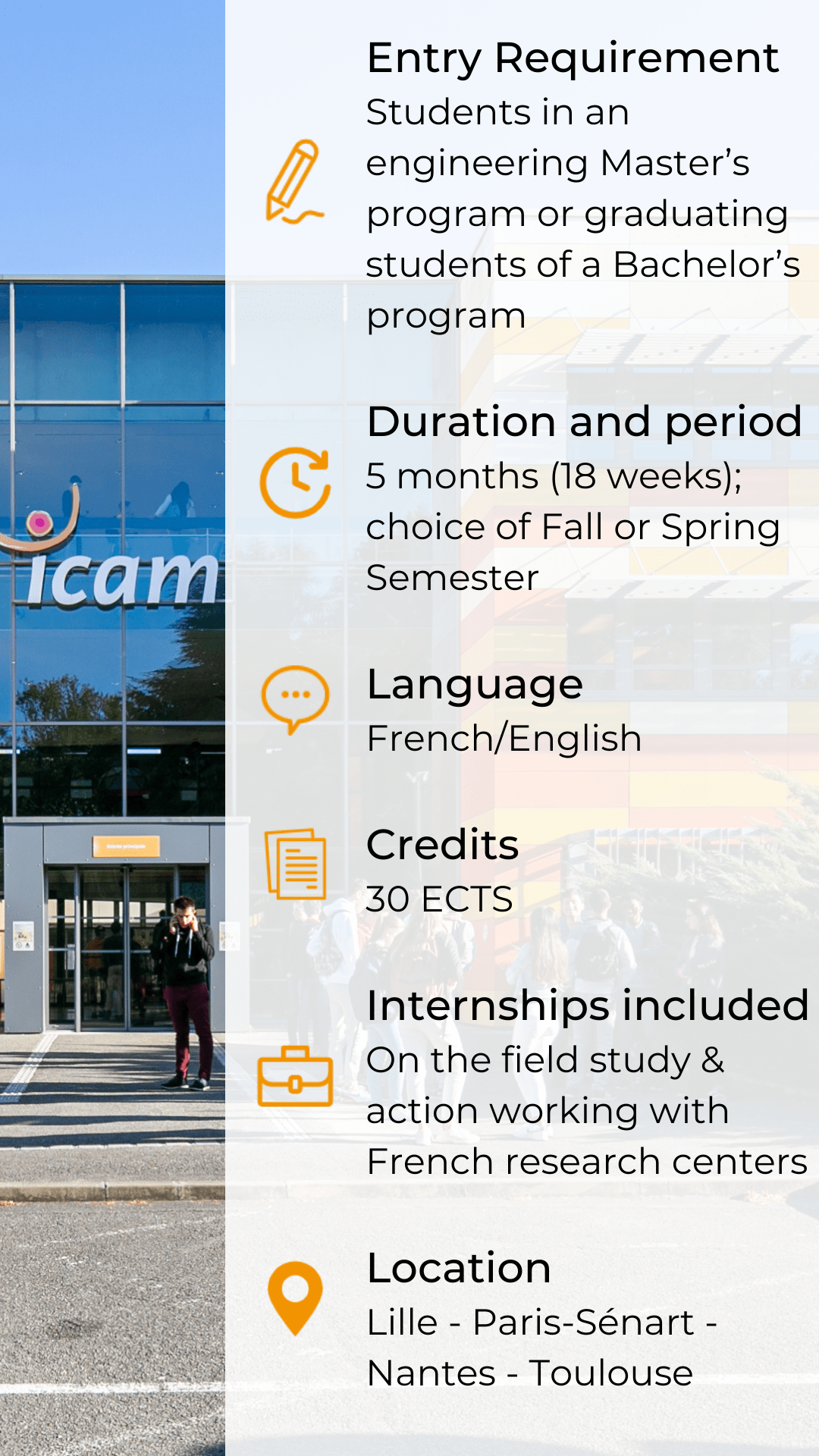
    • The complexity of the scientific thesis can be adapted to two levels:
      • for students in Engineering Master’s program
      • for students in the last year of their Scientific/Engineering Bachelor’s program. Juniors may already start applying if their universities already start thesis preparation in their junior year. 
    • Personal motivation
    • Eager to gain exposure to the different engineering fields, and management practices
    • Keen to work with research experts
    • Language requirement: A B1 level in English and French is recommended. 
  • Tuition fees
    • Students from Partner Institutions: Students are bound by the general terms and conditions of registration at their home institution. Student exchange contracts stipulate that students will pay tuition and other administrative fees at the home institution.
    • Students from non-Partner Institutions: N/A – This program is currently open to students coming from partner institutions.

All students are expected to cover the cost of their travel to and from the host university and their living expenses. To estimate your other essential expenditures, please refer to our sample budget. You can also check if you may benefit from scholarships and grants, details of which are shown in this link.

How to apply

Please refer to the procedures proposed by your internationationalization department or your program advisor. Should you have any other questions, feel free to contact us below: