


BIOPRIME: Icam at the Heart of a Revolutionary Project
Research
13 Jan 2026
Icam is embarking on an ambitious research project called BIOPRIME that could transform the lives of millions of patients suffering from lower back pain.
Supported by the French National Research Agency, this four-year project, led by Karim Kandil, a lecturer-researcher specializing in biomimetic materials at Icam’s Lille campus, aims to develop a new generation of lumbar prostheses. Here’s what you need to know.
A Major Public Health Issue
In France, 4 out of 5 people suffer from lower back pain at some point in their lives, according to the French National Health Insurance Fund. These lumbar disorders represent the second leading cause of long-term work absences and generate €5 billion in annual costs (direct and indirect expenses combined).
However, in cases of severe disc damage, current surgical solutions remain unsatisfactory. Spinal fusion reduces patient mobility and accelerates the degeneration of adjacent discs. As for existing disc prostheses, they partially preserve movement but do not reproduce the biomechanical complexity of a natural disc. The result: only about half of patients experience optimal long-term relief with current implants. Complications affect up to 40% of patients, and up to 35% require reoperation, according to several recent studies.
BIOPRIME: A Disc Prosthesis Close to Nature
The BIOPRIME project proposes a revolutionary approach. It aims to design a disc prosthesis capable of mimicking the structure and mechanical behavior of a healthy intervertebral disc.
BIOPRIME relies on innovative internal structures printed in 3D, called lattices. These geometric micro-cells, whose shape and arrangement are precisely controlled, make it possible to recreate zones with varied mechanical properties: elasticity, rigidity, shock absorption, and resistance to specific stresses.
The goal? To restore biomechanics close to natural, reduce long-term complications, and sustainably improve patients’ quality of life.
Promising Prospects for Patients and Disc Surgery
If BIOPRIME’s objectives are achieved, the benefits could be significant:
- More natural mobility for operated patients.
- Reduction of post-operative pain and long-term complications.
- Increased implant longevity, limiting re-interventions.
- A new era for disc surgery, where prostheses no longer simply replace but restore the functions of a healthy disc.
“The success of a prosthesis does not only depend on its strength, but on its ability to restore the complex behavior of the tissue it replaces,” emphasizes Karim Kandil, lecturer-researcher at Icam Lille campus and specialist in mechanics of polymer materials and biological tissues. “With BIOPRIME, we want to overcome the limitations of current implants to offer patients a solution finally adapted to human physiology.“
A Multidisciplinary and Collaborative Approach
Launched in November 2025, BIOPRIME is based on an unprecedented collaboration between scientists, engineers, and neurosurgeons. The project brings together the biomechanics lecturer-research team at Icam Lille, the Civil Engineering and geo-Environment laboratory (LGCgE) of the University of Lille, and the neurosurgeons of Ramsay Santé hospital, ensuring a scientific, technical, and clinical approach.
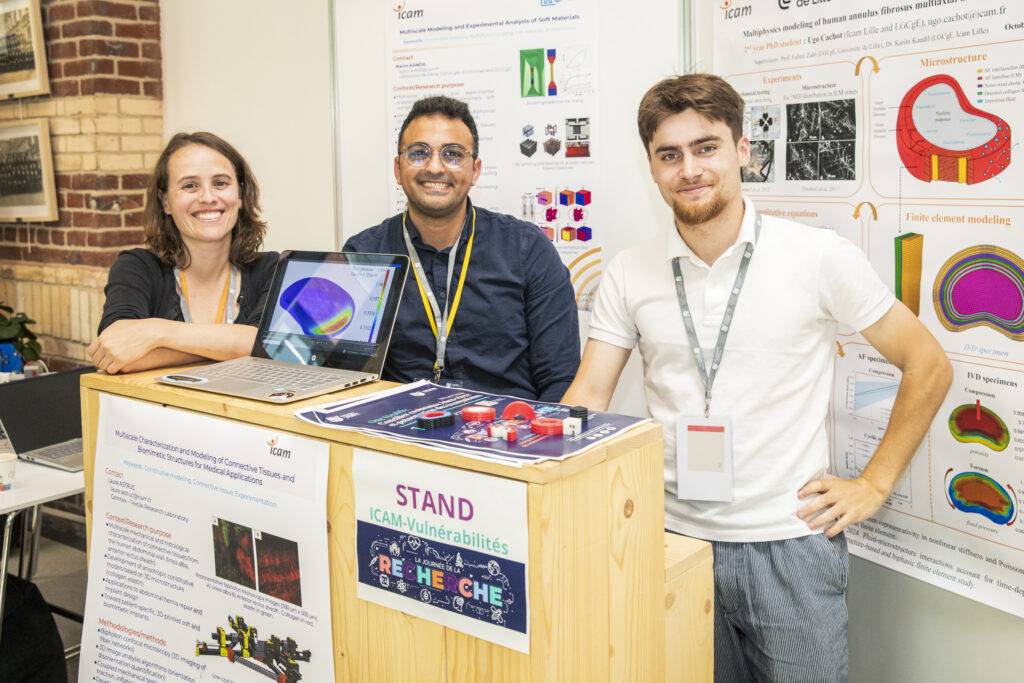
Part of the Icam Lille biomechanics team with Karim Kandil in the center.
The BIOPRIME project is supported by the French National Research Agency with funding of €300,000 as part of its Young Researchers program (JCJC).